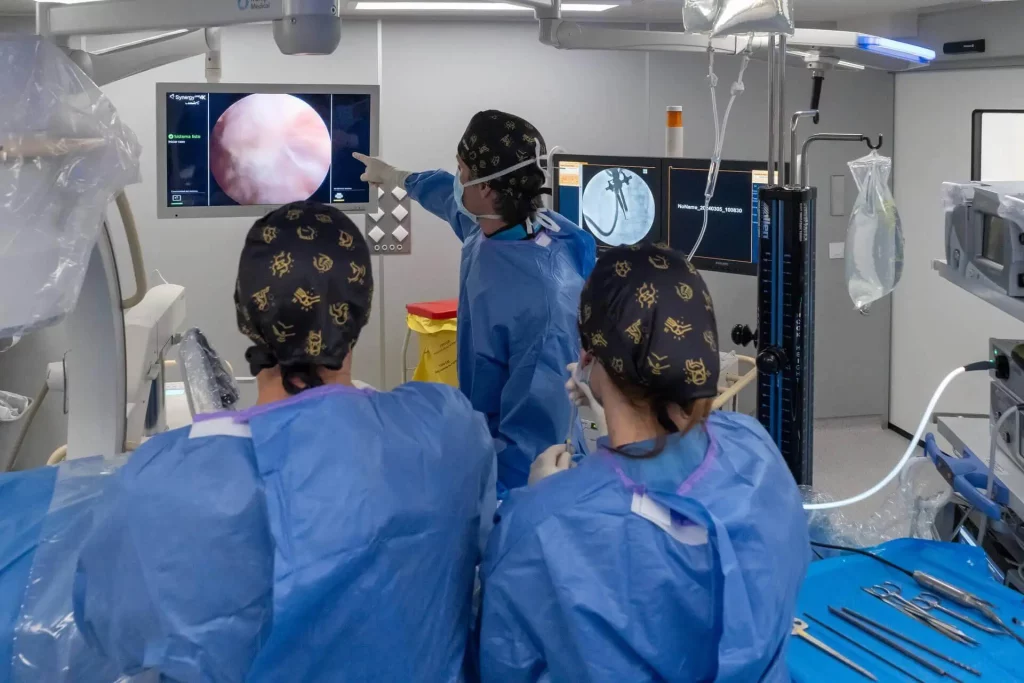
The tethered cord in adults is uncommon, but it can explain atypical low back or pelvic pain, changes in gait, weakness, tingling and urinary or bowel problems. The key is not a single MRI, but the sum of symptoms, neurological examination, imaging tests and clinical course. Some cases are observed, while others require surgery to release tension on the cord and prevent progressive deterioration.
- The tethered cord occurs when the spinal cord is fixed by tissues that limit its normal movement.
- In adults it can present with unusual low back pain, leg symptoms, urinary disturbances, sensory changes or worsening with spinal flexion.
- MRI is the main test, but an isolated image is not enough to decide treatment.
- Surgery is considered mainly if there are progressive symptoms, neurological deficit, urological involvement or clear functional deterioration.
- Recovery is variable: pain may improve before strength, sensation or bladder control.
What is the tethered cord
The spinal cord normally can move within the vertebral canal to some degree. In tethered cord syndrome, also called tethered cord syndrome, there is an abnormal fixation that generates tension on the spinal cord or the conus medullaris, the terminal part of the cord. That fixation can be due to a thickened or tense filum terminale, lipomas, congenital malformations, scarring after surgery, tumors, trauma or some types of spinal dysraphism.
In children it is often detected by skin signs, deformities or developmental alterations. In adults it can remain unnoticed for years and present with less clear symptoms: pain, tingling, weakness, urinary changes or functional decline. Sometimes it is discovered when investigating low back pain that does not fit a typical disc herniation, lumbar stenosis or common sciatica.
The critical point is not to turn any finding into an automatic surgical indication. There can be images compatible with tethering without relevant symptoms. There can also be suggestive symptoms with subtle findings. Therefore diagnosis requires clinical correlation: what the patient reports, what the examination shows and what tests demonstrate must fit together.
Symptoms and indications
Unusual low back, sacral or perineal pain
Pain can be located in the low lumbar area, sacrum, buttocks, groin, legs or perineal region. Sometimes it is described as burning, electric shocks, deep pressure or pain that does not follow the classic course of a nerve root. It may worsen with flexion, extension, exertion, prolonged standing, sports activity, pregnancy or trauma.
Leg and gait changes
Some people notice unusual fatigue when walking, tripping, loss of strength, cramps, balance disturbance or a clumsy leg sensation. Pes cavus, longstanding deformities, asymmetries or muscle wasting may also appear. If these changes progress, they should be investigated rather than attributed only to age, stress or muscle tightness.
Urinary, bowel or sexual symptoms
Urinary urgency, leakage, difficulty initiating urination, a sensation of incomplete emptying, recurrent urinary infections, severe constipation or loss of bowel control can be part of the picture. They do not always indicate a tethered cord, but they change the priority of evaluation when they occur together with neurological pain, weakness or sensory changes.
Skin signs or history
A deep dimple, vascular stain, tuft of hair, fatty lump in the lumbosacral area, prior surgery for spina bifida, spinal lipoma, trauma or previous spine surgery increase suspicion. In adults, asking about childhood history is important because some signs may have been considered irrelevant at the time.
Diagnosis
Diagnosis begins with a detailed medical history: onset, course, factors that worsen symptoms, pain location, leg symptoms, bladder, bowel, surgical history and functional changes. Then a neurological exam is performed: strength, reflexes, sensation, muscle tone, gait, balance and signs of conus medullaris or nerve root involvement.
Lumbar and lumbosacral MRI is the main test. It allows assessment of the position of the conus medullaris, the thickness of the filum terminale, lipomas, scars, diastematomyelia, cysts, tumors or signs of dysraphism. In selected cases this may be complemented with MRI of the entire spine, contrast studies, CT, myelography, neurophysiology or urodynamic studies. Urodynamics evaluates bladder function and can be very useful if there are urinary symptoms.
The difficulty lies in “occult” or subtle cases. A striking image without symptoms does not have the same meaning as a subtle image with progressive neurological deterioration. Recent reviews emphasize that imaging alone should not replace clinical assessment. The goal is to answer a specific question: whether there is relevant cord tension and whether treating it can prevent worsening or improve symptoms.
Non-surgical and surgical alternatives
Observation and follow-up
If there are no significant symptoms, if findings are incidental or if the condition is stable, observation can be considered. Observing does not mean ignoring: it involves follow-up visits, neurological control, monitoring symptoms and repeating tests if there are changes. It also allows avoiding surgery when the risk–benefit balance is not favorable.
Conservative treatment
Non-surgical treatment can include tailored physiotherapy, pain control, education about neuropathic pain, pelvic floor management if appropriate and urological treatment. Physiotherapy should be cautious: strength, mobility and motor control exercises can help, but aggressive manipulations or intense stretches are not appropriate if significant cord tension is suspected.
Untethering surgery
Surgery aims to free the spinal cord or roots from structures that generate tension. Depending on the cause, it may consist of filum terminale section, scar release, lipoma treatment, correction of a malformation or more complex approaches. In some adults with re-tethering or high risk of neurological injury, alternatives such as vertebral shortening have been described, but these are highly selected procedures.
Surgical indication is stronger when there is disabling pain compatible with the condition, neurological deterioration, progression of weakness, objective urological changes, gait alteration or documented worsening. In asymptomatic patients or those with minimal symptoms, preventive surgery is more debatable and should be considered with special caution.
Benefits, risks and adverse effects
The potential benefit of surgery is to reduce tension on the cord, halt deterioration, improve pain and protect neurological or urological function. Pain is usually the symptom that may improve most clearly in some patients. Strength, sensation and bladder function may improve, stabilize or persist, especially if damage has been present for a long time.
Risks include infection, bleeding, cerebrospinal fluid leak, postoperative pain, nerve root injury, worsening of strength, sensation, bladder or bowel function, adhesions and re-tethering. Revision surgeries may carry higher risk due to scarring and altered anatomy. There are also general anesthesia risks, thrombosis and wound complications.
A good decision avoids two extremes: operating on an image without clear symptoms and delaying evaluation when real deterioration exists. The goal is not to promise a cure, but to choose the option with the highest probability of preserving function and reducing suffering with the least reasonable risk.
Referral criteria
Referral to neurology, neurosurgery or a spine unit is advisable if there is atypical low back or pelvic pain with neurological symptoms, gait disturbances, progressive weakness, urinary or bowel changes, history of dysraphism, lipoma, spina bifida, spinal surgery or an MRI that mentions a low conus, thickened filum, filum lipoma, diastematomyelia, tethered cord or re-tethering.
Referral should be prompt if the patient is losing strength, walking worse, falling, worsening urinary or bowel control, presenting saddle anesthesia or accumulating progressive symptoms. In these cases, waiting months without a plan can increase the risk of damage that is difficult to reverse.
Realistic recovery times
After untethering surgery, hospital stay and initial rest depend on the technique, age, general condition and whether there was a CSF leak or complex revision. Many people need to limit exertion for several weeks and reintroduce activity gradually. Physiotherapy usually focuses on gait, strength, balance, exercise tolerance and protection of the surgical area.
Pain may improve within weeks, although it does not always disappear. Sensation and strength can take months. Bladder and bowel recovery is especially variable: sometimes they improve, sometimes they stabilize and sometimes prolonged urological follow-up is required. If symptoms had been present for years or there was established neurological damage, complete recovery is less likely. A realistic expectation is to seek functional improvement or stabilization, not guaranteed immediate normality.
When to go to the emergency room
Go to the emergency room if there is sudden or progressive loss of leg strength, new difficulty walking, repeated falls, inability to urinate, new incontinence, loss of bowel control, anesthesia in the genital or anal area, fever with intense back pain, rapidly worsening postoperative pain or clear fluid leaking from a wound.
Myths and realities
Myth: “Tethered cord only affects children.”
Reality: It can be diagnosed in adults, especially if it was mild, occult or decompensated after mechanical changes, scarring or trauma.
Myth: “If the MRI says thickened filum, you must operate.”
Reality: The decision depends on symptoms, examination, progression and risks, not on an isolated phrase in the report.
Myth: “Surgery always restores bladder function.”
Reality: It may improve or stabilize, but chronic urological symptoms do not always reverse.
Myth: “Unusual low back pain is always a tethered cord.”
Reality: It is an uncommon cause. Herniated disc, stenosis, sacroiliac problems, hip issues, facet pain, neuropathies and other conditions should be considered first.
Frequently asked questions
Is tethered cord in adults common?
No. It is uncommon, but it may be underdiagnosed because its symptoms resemble low back pain, sciatica, urological problems or neuropathies.
Does a normal MRI rule out the problem?
Not always, but a well-performed MRI provides a lot of information. If suspicion is high, expert review, contrast, whole-spine imaging or complementary tests may be required.
Which symptom should worry me most?
Progression. Pain that changes, increasing weakness, worsening gait or new urinary and bowel changes carry more weight than a stable discomfort for years.
Can physiotherapy make it worse?
It can help if adapted. What should be avoided are aggressive manipulations, extreme stretches or programs that clearly increase neurological symptoms.
Is the surgery minimally invasive?
It depends on the cause and anatomy. Some filum terminale cases are more limited; others, especially revisions or complex lipomas, require more delicate surgeries.
Can it recur after surgery?
Yes. Re-tethering due to scar or symptom persistence can occur. That is why follow-up is important, especially if pain, weakness or urinary symptoms reappear.
What happens if I don’t have surgery?
It depends on the case. If there are no symptoms or they are stable, observation may be reasonable. If there is neurological deterioration, delaying treatment can increase the risk of persistent deficit.
Does the pain disappear completely?
It cannot be guaranteed. Many surgical decisions aim to relieve pain and, above all, halt deterioration. The outcome depends on duration, cause and prior neurological status.
Glossary
Tethered cord: abnormal fixation of the spinal cord that limits its movement.
Conus medullaris: the lower end of the spinal cord.
Filum terminale: a thin structure that connects the conus medullaris to the sacral region.
Spinal dysraphism: a group of developmental malformations of the spine and cord.
Diastematomyelia: splitting of the cord by a bony or fibrous structure.
Urodynamics: a test that measures bladder function.
Untethering: surgery to free the cord or roots from tethering tissues.
Re-tethering: new fixation of the cord after surgery or scarring.
References
- AANS. Tethered Spinal Cord Syndrome. https://www.aans.org/patients/conditions-treatments/tethered-spinal-cord-syndrome/ 2024.
- NINDS. Tethered Spinal Cord Syndrome. https://www.ninds.nih.gov/health-information/disorders/tethered-spinal-cord-syndrome 2026.
- NCBI Bookshelf. Tethered Cord Syndrome. StatPearls. https://www.ncbi.nlm.nih.gov/books/NBK585121/ 2023.
- AHRQ. Diagnosis and Treatment of Tethered Spinal Cord. https://www.ncbi.nlm.nih.gov/books/NBK609065/ 2024.
- PCORI. Diagnosis and Treatment of Tethered Spinal Cord, systematic review. https://www.pcori.org/research-results/2023/diagnosis-and-treatment-tethered-spinal-cord-systematic-review 2024.
- Pediatrics. Diagnosis and Treatment of Tethered Spinal Cord: A Systematic Review. https://publications.aap.org/pediatrics/article/154/5/e2024068270/199709/Diagnosis-and-Treatment-of-Tethered-Spinal-Cord-A 2024.
- Journal of Neurosurgery: Spine. Clinical criteria for filum terminale resection in occult tethered cord syndrome. https://thejns.org/spine/view/journals/j-neurosurg-spine/40/6/article-p758.xml 2024.
- PubMed. Surgical Treatment of Tethered Cord Syndrome in Adults. https://pubmed.ncbi.nlm.nih.gov/32001403/ 2020.
- PubMed. Management of Tethered Cord Syndrome in Adults. https://pubmed.ncbi.nlm.nih.gov/27593774/ 2017.
- UCLA Health. Adult Tethered Cord Syndrome. https://www.uclahealth.org/medical-services/neurosurgery/conditions-treated/adult-tethered-cord 2026.
- Cleveland Clinic. Tethered Spinal Cord. https://my.clevelandclinic.org/health/diseases/24672-tethered-spinal-cord 2023.
Health education notice
This content is informative and does not replace an individual medical evaluation. It does not allow for diagnosis or surgical decision-making on its own. If there is loss of strength, walking problems, changes in urinary or bowel control, fever, severe pain or rapid worsening, seek urgent medical attention.