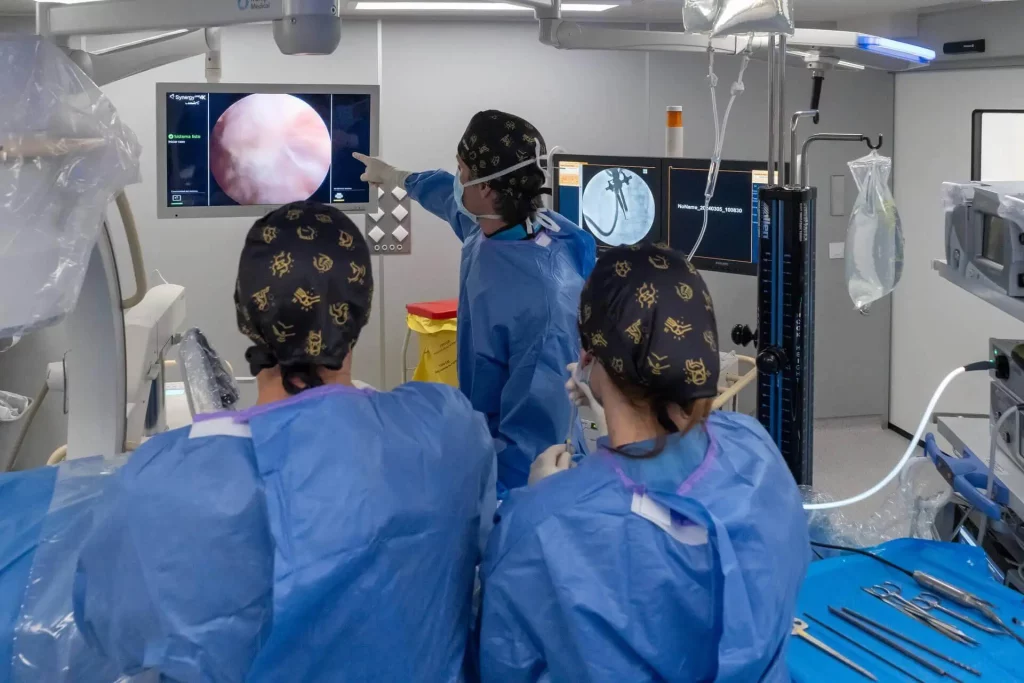
ACDF, the abbreviation for anterior cervical discectomy and fusion, is one of the best-known surgeries to treat neck problems that irritate a nerve root or compress the spinal cord. Still, it raises very specific questions: whether it is truly necessary, whether it relieves arm pain, whether it leaves the neck permanently stiff, and how long real recovery takes.
The reality is neither as simple nor as alarming. ACDF can relieve symptoms and improve function in well-selected patients, but it is not the automatic answer for every cervical herniation or every neck pain. Before reaching that conversation, it is very important to confirm the diagnosis, understand what alternatives exist, and know which risks are uncommon but important.
Summary
ACDF is mainly considered when there is pain radiating to the arm, numbness, loss of strength, or spinal cord compression and conservative treatment has not been sufficient, or when the neurological problem is progressing. It usually provides reliable relief in well-chosen patients, but it has limits, risks, and a recovery process that should be understood in phases. The best decision does not depend only on the MRI, but on the combination of symptoms, examination, tests, and the real clinical objective.
- Not every neck pain with arm symptoms requires ACDF.
- Surgery weighs more when there is persistent radicular pain, progressive weakness, or signs of myelopathy.
- ACDF does not compete equally with all techniques. Sometimes the best alternative is cervical disc arthroplasty, and other times a posterior foraminotomy.
- Mild difficulty swallowing for a few days can occur, but there are warning signs that require earlier consultation.
- Pain improvement can precede recovery of sensation or strength.
- Functional recovery is usually measured in weeks, but fusion consolidation takes longer.
What an ACDF is and why it is indicated
ACDF is a surgery performed from the front of the neck. The goal is to remove the disc or disc-osteophyte complex that is compressing a nerve root or the spinal cord, decompress the neurological structures, and stabilize that level by fusing two vertebrae. In simple terms, it aims to remove the pressure and prevent that segment from continuing to move in a way that keeps causing the conflict.
It is not proposed based solely on an impressive MRI. It is considered when what appears on tests fits what you feel and what is found on examination. In cervical radiculopathy, the problem is usually a nerve root. In cervical myelopathy, the structure affected is the spinal cord, and the threshold for concern is usually higher because we are talking about balance, hand dexterity, and sometimes sphincter function.
Symptoms and indications that put it on the table
The most typical situation is a person with pain that radiates from the neck to the shoulder, arm, or hand, accompanied by tingling, electric-shock sensations, or loss of strength. Often the arm pain bothers more than the neck pain. That clinical clue matters a lot because it usually points to cervical radiculopathy rather than nonspecific muscle pain.
ACDF is usually discussed when one or more of these situations occur: persistent pain despite well-executed conservative treatment, progressive weakness, functional clumsiness of the arm or hand, or signs of spinal cord compression. When myelopathy appears, signs can seem small at first: clumsy hands, dropping objects, an unusual gait, frequent tripping, or a feeling of stiffness and slowness in the legs.
There are also situations that require accelerating evaluation: worsening weakness, gait disturbances, falls, new bladder or bowel problems, or pain with intense neurological symptoms that prevent a minimal normal life. Then the question stops being only “does it hurt?” and becomes “is the nerve or spinal cord being damaged in a way that should not be left to progress?”.
How the diagnosis is confirmed
The diagnosis should not be based only on imaging. Magnetic resonance imaging is the key test to see discs, osteophytes, the canal, and the cord, but it does not decide on its own. Many people have degenerative findings without needing surgery. What matters is clinical correlation: what symptoms you have, which neurological level appears affected, and whether the imaging truly explains that pattern.
Evaluation usually combines a detailed history, neurological examination, MRI and, in some cases, dynamic X-rays or CT. X-rays can provide information about alignment and instability. CT is more helpful when there is bony doubt, significant spurs, or specific planning needs. If degenerative myelopathy is suspected, interpretation of the whole picture must be especially careful.
Non-surgical alternatives
In most cervical radiculopathies without red flags, it is reasonable to start with conservative treatment. This usually includes rational analgesia, adapted activity, targeted physiotherapy, and enough time to see if the nerve calms down. Primary care and orthopedics guidelines agree that not every stable case needs immediate surgical referral.
Continuing without surgery makes more sense when strength is preserved, there are no spinal cord signs, and there is a clear trend toward improvement. It becomes less sensible when radicular pain remains highly limiting, weakness progresses, or signs of myelopathy appear. At that point, delaying the surgical conversation may be less neutral than it seems.
Surgical alternatives
ACDF is not the only possible surgery. In some patients, the alternative may be a cervical disc arthroplasty, especially when the goal is to decompress while preserving motion in an appropriate anatomical profile. In others, a posterior cervical foraminotomy can relieve a compressed root without fusing. They do not always compete for the same patient, because they depend on the location of compression, neck alignment, arthritis, stability, and whether there is spinal cord involvement.
Recent trials and reviews show that posterior foraminotomy can be noninferior to anterior surgery in well-selected patients with unilateral radiculopathy, and that cervical arthroplasty provides comparable or better long-term results than ACDF in some scenarios. That does not mean ACDF is obsolete. It means the correct surgery depends less on the technique’s name and more on the real pattern of the problem.
Expected benefits versus real risks
In well-selected patients, ACDF usually relieves radicular pain and improves arm function. When the problem includes spinal cord compression, the goal may be to halt neurological deterioration and recover part of the function, although recovery is not always complete. An important idea is that pain often improves before numbness or strength.
That said, it is not a risk-free surgery. Known problems include dysphagia or difficulty swallowing, hoarseness or voice changes, infection, pseudarthrosis, hematoma, neurological injury and, in the long term, adjacent-segment disease. Difficulty swallowing is among the most discussed complications after anterior cervical surgery, and it is usually transient, though in a minority it may require closer follow-up.
It is also not helpful to sell a false idea of total stiffness. A fusion eliminates motion at the treated segment, but it does not turn the entire neck into an immobile structure. The functional impact depends on the number of levels, the preexisting condition, and later adaptation. Still, in very specific profiles, discussion of cervical arthroplasty to try to preserve segmental motion can be relevant.
Criteria for referral and second opinion
Specialist evaluation is advisable if there is persistent radicular pain that prevents sleeping, working, or using the arm normally, if strength decreases, if the hand becomes clumsy, if signs of myelopathy appear, or if surgery has already been discussed but you do not clearly understand why that technique and not another. A high-quality second opinion is not meant to contradict, but to confirm that the diagnosis, the affected level, and the surgical goal fit together.
Realistic recovery times
Recovery after ACDF cannot be summarized well in a single figure. There is clinical recovery and biological consolidation, and they do not move at the same pace. Many people get up and walk very soon, may stay one night or even less hospitalized in selected cases, and notice relief of arm pain in early phases. But that does not mean everything is “cured” in a few days.
As a guideline, the first weeks usually focus on pain control, swallowing, basic mobility and walking. Then comes the phase of progressive functional recovery, where posture, return to work, sleep and tolerance for activities matter. Return to work depends heavily on the job type. In cervical surgery, recent reviews suggest that motion-preserving techniques may favor a somewhat quicker return to work in some contexts, but that does not make ACDF a poor option when it is the correct technique.
It is also worth knowing that rehabilitation is not decorative. Recent literature on functional recovery after cervical and lumbar surgery emphasizes the value of progressive exercise and patient education to improve pain, function and confidence in returning to normal life.
When to go to the emergency room
After ACDF you should not wait until the next appointment if you experience difficulty breathing, increasing inability to swallow, marked neck swelling, fever with clear worsening pain, wound discharge, new or progressive loss of strength, sudden worsening of gait, or changes in bladder or bowel control. These are uncommon signs, but they are important enough not to be trivialized.
Myths and realities
Myth 1: if they propose ACDF it means there is nothing left to try
Reality: it is often proposed after a reasonable period of conservative treatment, but it can also be considered earlier if strength worsens or the spinal cord is affected.
Myth 2: the MRI decides on its own
Reality: the image helps a lot, but surgery is decided by the combination of symptoms, examination and tests.
Myth 3: after a fusion I will not be able to move my neck normally
Reality: motion is lost at the operated segment, not necessarily overall practical neck function. The impact depends on the case.
Myth 4: if I have trouble swallowing for a few days, it is always serious
Reality: transient dysphagia is relatively common after anterior cervical surgery, but if it progresses or is accompanied by breathing problems, seek immediate consultation.
Myth 5: if arm pain improves, strength will recover at the same pace
Reality: neurological improvement can occur in phases and strength may take longer than pain to recover.
Frequently asked questions
Does ACDF always relieve arm pain?
Not always. In well-selected patients it usually relieves it significantly, but the outcome depends on the duration of compression, the type of lesion and whether the nerve already had prolonged damage.
Is it normal to have difficulty swallowing afterwards?
It can occur, especially initially. The important thing is to monitor whether it improves gradually or worsens, is accompanied by significant choking episodes, or causes breathing difficulty.
How long does recovery take?
Initial functional recovery is usually measured in weeks, but full consolidation of the fusion takes longer and the pace varies depending on the number of levels, overall health and the type of work.
Can I return to work soon?
It depends on the job. A sedentary job may allow an earlier return than one involving lifting, twisting or sustained postures. The decision must be individualized.
Does ACDF leave the neck permanently stiff?
It fixes the treated segment, but does not necessarily imply a globally disabling stiffness. The practical effect varies by case and the number of operated levels.
When does surgery weigh more than waiting?
When very disabling radicular pain persists despite correct conservative management, when weakness progresses, or when there are signs of myelopathy.
:contentReference[oaicite:56]{index=56}
What alternative can there be to ACDF?
In some cases, cervical disc arthroplasty or posterior cervical foraminotomy. The best alternative depends on the anatomy, the location of compression, and the clinical objective.
Glossary
- Cervical radiculopathy: irritation or compression of a nerve root in the neck that typically causes arm pain, tingling or weakness.
- Cervical myelopathy: involvement of the spinal cord in the neck, with possible problems in the hands, gait or sphincters.
- Fusion or arthrodesis: joining two vertebrae to stabilize a segment.
- Cervical disc arthroplasty: an implant that replaces the disc and aims to preserve motion in selected cases.
- Foraminotomy: surgery that enlarges the opening through which a nerve root exits.
- Pseudarthrosis: failure of the fusion to consolidate (nonunion).
- Adjacent segment: the level next to the operated one that over time can develop symptomatic changes.
References
- Surgical Treatment for Cervical Radiculopathy – AAOS OrthoInfo – 2025.
- Neck Pain – Cervical Radiculopathy: Management – NICE CKS – 2025.
- AO Spine Clinical Practice Recommendations for Diagnosis and Management of Degenerative Cervical Myelopathy – 2025.
- Posterior Cervical Foraminotomy Compared with Anterior Cervical Discectomy with Fusion for Cervical Radiculopathy: Two-Year Results of the FACET Randomized Noninferiority Study – 2024.
- Ten-Year Outcomes of Cervical Disc Arthroplasty Versus Anterior Cervical Discectomy and Fusion: A Systematic Review with Meta-Analysis – 2024.
- Ambulatory Care vs Overnight Hospitalization After Anterior Cervical Discectomy and Fusion for Cervical Radiculopathy: Randomized Clinical Trial – 2024.
- Postoperative Complications of Anterior Cervical Discectomy and Fusion: A Comprehensive Systematic Review and Meta-Analysis – 2025.
- Return to Work After Anterior Cervical Disk Replacement vs Fusion: A Systematic Review and Meta-Analysis of Randomized Controlled Trials – 2025.
- Postoperative Rehabilitation for Pain and Functional Recovery After Cervical and Lumbar Spine Surgery: A Literature Review – 2025.
- ACDF Surgery – Cleveland Clinic – 2024.
This content is health education and does not replace an individual medical assessment. The decision to operate, wait, or choose a specific technique should be made with neurological examination, well-interpreted tests and the complete clinical context.