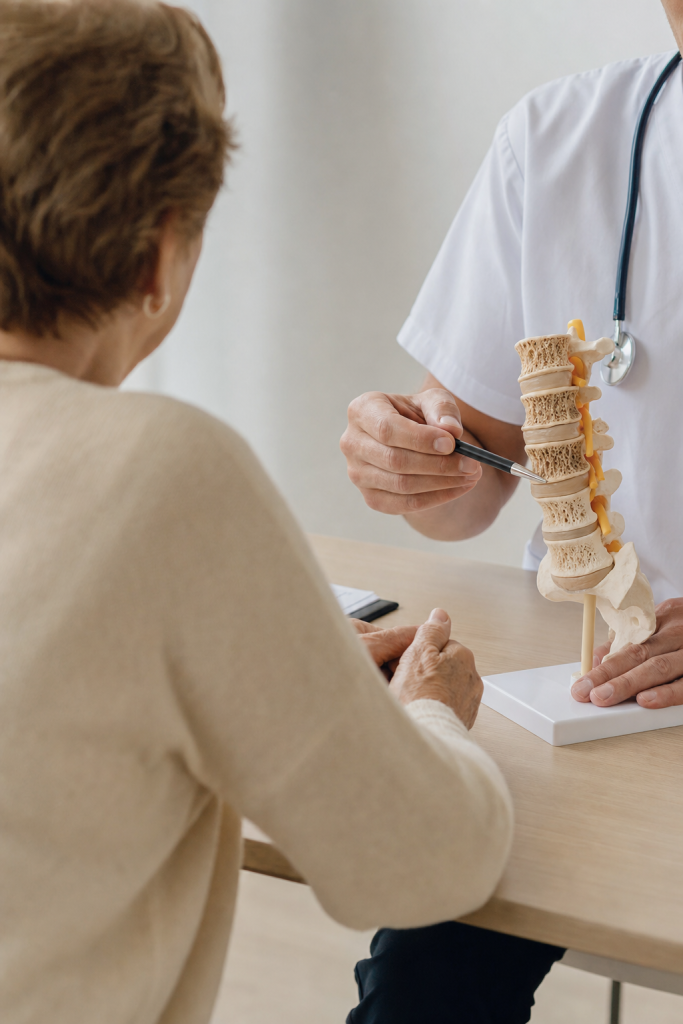
Osteoporosis in the spine does not always prevent surgery, but it can significantly change the surgical plan. When the bone is fragile, the decision does not depend only on the MRI or the symptoms: bone quality, the risk of implant loosening, the possibility of nonunion of the fusion and whether it is advisable to optimize the bone before operating must also be assessed. Understanding these nuances helps make safer and more realistic decisions.
- Spinal osteoporosis increases the risk of mechanical complications.
- Not all surgeries are planned the same way when bone is fragile.
- Bone densitometry is only part of the evaluation.
- Sometimes it is advisable to treat the bone before operating.
- The surgical technique can be adapted to the bone condition.
- Recovery usually requires more monitoring and patience.
- The goal is to stabilize without overloading weak bone.
What it is and why it happens
Osteoporosis is a skeletal disease in which bone loses density and also internal quality, so it becomes more fragile and breaks more easily. When we talk about spinal osteoporosis, we refer to the impact of that weakened bone on the vertebrae, the discs and, above all, on the ability to anchor implants if surgery is required. In spinal surgery, the problem is not only “having less bone,” but that this bone holds screws worse, tolerates loads less well and can deform or collapse more easily after the operation.
Osteoporosis arises from a combination of factors: age, menopause, family history, low body weight, sedentary lifestyle, vitamin D deficiency, smoking, alcohol, prolonged steroid use and certain endocrine or digestive diseases. In the spine, bone fragility can also coexist with adult deformities, vertebral compression fractures, spondylolisthesis, stenosis or previous surgeries. That is why spinal osteoporosis is not considered an isolated data point, but a central piece of the surgical plan.
In many patients, the question is not “can we operate?”, but “how should we operate so the bone can support the procedure?”. That distinction is essential. A spine with osteoporosis may require a different strategy regarding the number of levels to fix, the type of screw, the implant trajectory, the use of bone cement or the decision to delay surgery for weeks or months to improve bone before going to the operating room.
Symptoms and warning signs
Osteoporosis itself may be asymptomatic until a fracture occurs. However, in surgical practice there are indirect signs that suggest spinal osteoporosis or compromised bone quality: loss of height, increasingly stooped posture, relatively sudden onset thoracic or lumbar pain, pain that worsens with micro-efforts, a history of prior vertebral fracture or several recent falls. In patients who are candidates for surgery, a history of failed surgeries, loosened screws or loss of correction in previous interventions is also concerning.
Warning signs that require expedited evaluation include severe pain after a minimal fall, inability to remain upright, persistent night pain, visible new deformity, leg weakness, progressive tingling or loss of bowel or bladder control. Although some of these symptoms may be related to other spinal pathologies, in a person with fragile bone the possibility of vertebral fracture or mechanical instability deserves special attention.
It is also important to distinguish between mechanical pain and inflammatory or neurological pain. Spinal osteoporosis may not be painful by itself, but it can make an existing pathology — for example, stenosis or a deformity — behave worse and force modification of the surgical plan. In that context, pain intensity does not always reflect the structural severity of the problem; therefore clinical examination and imaging are decisive.
How it is diagnosed: imaging tests and examination
The diagnosis of spinal osteoporosis before surgery does not depend on a single test. The basis is usually bone densitometry, a technique that measures bone mineral density, normally at the hip and lumbar spine. Still, in patients with significant osteoarthritis, deformity or prior surgery, densitometry can underestimate or overestimate the real bone quality, so it is often complemented with other tools.
Computed tomography (CT) allows analysis of bone architecture and, in some cases, indirect estimation of vertebral strength. Magnetic resonance imaging (MRI) does not measure density, but it helps evaluate recent fractures, bone edema, neural compression and associated degenerative changes. In selected patients, the workup may include blood tests to look for secondary causes of osteoporosis: vitamin D, calcium, renal function, parathyroid hormone, thyroid profile or bone metabolism markers.
Clinical examination also matters a great deal. The specialist observes posture, trunk alignment, walking balance, strength, sensation, reflexes and the pain pattern. If there is progressive deformity, a prior fracture or signs of instability, the surgery may require more extensive planning. In spinal osteoporosis, even details such as pedicle size, fixation length or sacral bone quality influence the final design of the intervention.
What is sought before operating
Before spinal surgery, the goal is not only to confirm that osteoporosis exists, but to estimate whether the bone will bear the load it will receive. Signs of global fragility, fracture risk, tendency to poor healing and probability of implant failure are sought. In short, the practical question is whether spinal osteoporosis requires reinforcement of fixation, a change in strategy or postponement of the intervention to optimize the bone.
Non-surgical treatment alternatives
Not every person with spinal osteoporosis needs immediate surgery. If the indication is not urgent, medical optimization of bone is usually prioritized. This includes calcium and vitamin D when indicated, specific pharmacological treatment for osteoporosis and, in certain cases, anabolic drugs that promote bone formation. The choice depends on the patient’s profile, fracture risk and the type of surgery planned.
In addition to pharmacological treatment, habits and correctable factors are reviewed: quitting smoking, improving protein intake, fall prevention, reviewing medications that increase fragility risk and treating nutritional deficiencies. If there is pain from a stable vertebral fracture or mechanical overload, analgesics, braces in selected cases and adapted rehabilitation may be indicated. The goal is not simply to “hold on,” but to reach surgery with the best possible bone or, if surgery is not necessary, to avoid it with safe measures.
In patients with stenosis or degenerative pain without neurological urgency, it sometimes makes sense to gain time to strengthen bone quality. That pause can change the surgical prognosis. Spinal osteoporosis is not corrected in days, but it can improve enough to reduce complication risk when the case allows waiting.
Surgical alternatives
When surgery is necessary, the plan must be adapted to the fragile bone. In spinal osteoporosis, an isolated decompression may be sufficient in some cases, but if there is instability, deformity or risk of progression, fixation is usually considered. The key is that the technique should not be an exact copy of what would be used in healthy bone. The objective changes: it is not enough to correct the pathology, the implant must achieve reliable anchorage.
Options include arthrodesis or spinal fusion, instrumentation with screws and rods, extending levels to distribute loads, fixation with cement-augmented screws, screws with trajectories that increase cortical purchase and, in some cases, pelvic fixation when distal stability is critical. Minimally invasive surgery may also be considered to reduce tissue trauma and blood loss, although the indication depends on anatomy, pathology and the real need for stability.
In deformities or complex reconstructions, planning may include strategies to minimize subsidence of interbody cages, avoid overcorrection and protect the proximal junction of the construct. In spinal osteoporosis, every technical detail matters: screw diameter and length, trajectory, number of levels fixed, use of cement, type of graft and order of correction. Good surgery is not the most “aggressive,” but the one best adapted to the available bone.
What really changes in the technique
Three things change most: the way the material is anchored, the extent of fixation and the strategy to promote fusion. When bone is more fragile, the surgeon may prefer implants that distribute load better, cement reinforcement, additional pelvic support or a more conservative correction plan. In other words, spinal osteoporosis influences not only “if to operate,” but “how to operate” and “when to do it.”
Benefits, risks and adverse effects
The main benefit of adapting surgery to spinal osteoporosis is reducing the risk of mechanical failure and improving the chance of a stable outcome. When the indication is correct, surgery can relieve pain, protect neurological function, correct deformity and improve mobility. It can also prevent structural worsening that would be more difficult to treat later.
However, the risks are greater than in patients with good bone. There may be screw loosening, implant subsidence, pseudarthrosis — that is, failure of fusion — adjacent fractures, loss of correction, infection or need for revision surgery. Osteoporosis can also increase the patient’s overall frailty, so recovery may be slower and requires closer follow-up.
Adverse effects are not only surgical. Some bone treatments require time to take effect, others are chosen based on comorbidities and some need coordination with endocrinology, rheumatology or internal medicine. That is why spinal osteoporosis is best managed in a multidisciplinary way. The ideal balance is not to delay a necessary surgery, but also not to operate without adequate bone assessment.
Referral criteria to a specialist
Referral to a spine specialist is advisable when there is persistent pain with deformity, vertebral fracture, failure of conservative treatment, neurological signs, prior surgery with suspected mechanical failure or the need for complex reconstruction. In patients with spinal osteoporosis, referral is especially important if a fusion, deformity correction or revision of previous hardware is being considered. The more complex the surgery, the more necessary it is to review bone status before deciding.
Patients with repeated fragility fractures, progressive height loss, worsening kyphosis, suspected pseudarthrosis or a history of complications after prior surgeries should also be evaluated by a specialist. In many cases, the best time to consult is not when the pain becomes unbearable, but when imaging shows a problem that could worsen if the plan is not adjusted. Spinal osteoporosis requires forward thinking, not just rescue.
Realistic recovery times
Recovery times vary widely depending on the technique, the number of levels operated, age and bone condition. In mild spinal osteoporosis with limited surgery, recovery can follow a course quite similar to other patients, although it usually requires more monitoring. In larger surgeries, return to normal activity can be slower because the bone needs to fuse more gradually and the implants must be protected for longer.
Realistically, the first weeks focus on pain control, early walking and avoiding sudden efforts. Return to light domestic activities may occur before resuming heavier loads, repeated twisting or physical jobs. If a fusion has been performed, bone consolidation can take months; in the presence of osteoporosis, that timeframe becomes even more important. Therefore, improvement in pain should not be interpreted as complete fusion.
In spinal osteoporosis, rehabilitation should be progressive, well guided and consistent with the type of fixation. Sometimes priority is given to walking, recovering basic mobility and avoiding falls. Other times flexion, rotation or loading are temporarily limited. The best recovery protects the implant without over-immobilizing the patient.
When to go to the emergency department
You should go to the emergency department if there is loss of strength in the legs, new difficulty walking, altered sensation in the perineal area, loss of control of urine or stool, unbearable pain after a minimal fall, fever with back pain or sudden deformity after a minor effort. In a person with spinal osteoporosis, these symptoms may indicate a vertebral fracture, neural compression or instability that should not wait.
It is also urgent to reassess a postoperative patient if pain suddenly worsens, if the wound shows redness or discharge, if new weakness appears or if posture changes noticeably in a few days or weeks. Osteoporosis increases the risk of some mechanical failures, so the threshold for evaluating a possible complication should be low. It will not always be serious, but it should be ruled out promptly.
Myths and realities
Myth: “If I have spinal osteoporosis, I cannot be operated on”
Reality: osteoporosis does not automatically prohibit surgery. What it does is require better assessment of the indication, optimize the bone if time allows and adapt the technique to reduce failures.
Myth: “Once operated, the bone no longer matters”
Reality: bone quality continues to matter after surgery because it conditions fusion, implant stability and the risk of adjacent fractures.
Myth: “Bone densitometry tells everything”
Reality: densitometry is very useful, but it does not always fully reflect the true strength of the vertebra. Sometimes CT, blood tests and clinical assessment are needed.
Myth: “Screws always loosen in osteoporosis”
Reality: the risk increases, but it can be reduced with good planning, appropriate fixation and bone-supporting measures.
Myth: “If it hurts less, it’s already healed”
Reality: pain improvement does not always mean the fusion has consolidated nor that the bone has regained strength. Structural recovery takes longer.
Myth: “Osteoporosis only affects older women”
Reality: it is more common in postmenopausal women, but it also occurs in men and in younger people with risk factors or secondary causes.
Frequently asked questions
Does spinal osteoporosis always change the type of surgery?
Not always, but it can change the technique, the extent of fixation, the type of implants or the decision to optimize bone before operating.
Can I have surgery if my densitometry is low?
In many cases yes. The issue is to assess the overall risk and decide whether to reinforce fixation or treat bone fragility first.
Is minimally invasive surgery always better in osteoporosis?
Not necessarily. It can be helpful to reduce tissue trauma, but the priority is achieving sufficient stability. Sometimes a more extensive surgery is safer.
How long should bone be treated before operating?
It depends on the case. In elective surgeries, it may be reasonable to wait weeks or months if that improves safety. In neurological emergencies, there is not always room to delay.
Is cement in screws dangerous?
It is not dangerous by itself when properly indicated and performed, but it has specific risks that the specialist should assess and explain.
Does osteoporosis increase the risk of pseudarthrosis?
Yes, because poorer quality bone may heal worse and provide less stability to the implanted material.
Can I return to sports afterwards?
In many patients yes, but the return depends on the type of surgery, consolidation and bone condition. Gradual progression and low-impact activities are usually recommended initially.
What if osteoporosis is discovered after the operation?
Then actions are taken to reduce the risk of new fractures, protect the fixation and treat bone fragility as soon as possible.
Glossary of medical terms
- Osteoporosis: a disease in which bone loses density and strength, with a higher risk of fractures.
- Osteopenia: a decrease in bone density less severe than osteoporosis, but which can be a warning sign of fragility.
- Bone densitometry: a test that measures the amount of mineral in bone to estimate its strength.
- Arthrodesis or spinal fusion: surgery that joins two or more vertebrae to stabilize the spine.
- Pseudarthrosis: failure of fusion after spinal surgery.
- Pedicular fixation: a system of screws placed in the vertebral pedicles to hold the spine.
- Cement augmentation: use of bone cement to reinforce the fixation of some implants in fragile bone.
- Vertebral compression: partial collapse of a vertebra, common in fragility fractures.
- Sagittal deformity: alteration of the lateral profile of the spine that can make the trunk lean forward or backward.
- Consolidation: the process by which bone unites and heals after a fracture or surgery.
References
- Optimization of spine surgery outcomes in patients with osteoporosis: a comprehensive narrative review (2026). https://pubmed.ncbi.nlm.nih.gov/42425505/
- Best Practice Guidelines for Assessment and Management of Osteoporosis in Adult Patients Undergoing Elective Spinal Reconstruction (2022). https://pubmed.ncbi.nlm.nih.gov/34690329/
- Management of osteoporosis in spine surgery (2015). https://pubmed.ncbi.nlm.nih.gov/25808687/
- Osteoporosis in spine surgery patients: what is the best way to diagnose osteoporosis in this population? (2020). https://pubmed.ncbi.nlm.nih.gov/32738802/
- Special Considerations to Improve Clinical Outcomes in Patients with Osteoporosis Undergoing Spine Surgery (2021). https://pubmed.ncbi.nlm.nih.gov/33900998/
- Tips and Tricks: Fixation Options in the Osteoporotic Cervical Spine (2025). https://pubmed.ncbi.nlm.nih.gov/40961948/
- Optimizing bone health before complex spinal surgery (2023). https://www.mayoclinic.org/medical-professionals/neurology-neurosurgery/news/optimizing-bone-health-before-complex-spinal-surgery/mac-20542607
- State-of-the-art techniques for complex spinal surgery (2026). https://www.mayoclinic.org/medical-professionals/neurology-neurosurgery/news/state-of-the-art-techniques-for-complex-spinal-surgery/mac-20599824
- Osteoporosis – Symptoms and causes (2026). https://www.mayoclinic.org/diseases-conditions/osteoporosis/symptoms-causes/syc-20351968
- Spinal fusion (2025). https://www.mayoclinic.org/tests-procedures/spinal-fusion/about/pac-20384523
- Minimally Invasive Spine Surgery (2024). https://www.aans.org/patients/conditions-treatments/minimally-invasive-spine-surgery/
Notice: this content is solely for educational and informational purposes and does not replace the assessment, diagnosis or treatment of a qualified healthcare professional. If you have any symptoms, consult a physician.
If symptoms persist or worsen, the most prudent action is to request an evaluation with a spine specialist, who can assess your specific case and guide you on the most appropriate options.