With support from AI tools
Adolescent scoliosis is a three-dimensional curvature of the spine that usually appears during growth and, in most cases, does not require surgery. The practical decision most relevant to families typically depends on three variables: how large the curve is, how much growth remains and whether the deformity progresses over time. Knowing when to monitor, when to brace and when to refer to a specialist helps avoid both excessive worry and delays in follow-up.
- Adolescent scoliosis does not always cause pain or obvious symptoms.
- Observation is common for small, stable curves.
- The brace aims to slow progression, not to fully “straighten” the spine.
- Skeletal maturity completely changes the clinical decision.
- Surgery is considered mainly for large or progressive curves.
- Appropriate follow-up is as important as the treatment itself.
- Some signs require accelerating referral to a specialist.
What adolescent scoliosis is and why it occurs
Adolescent scoliosis, more correctly called adolescent idiopathic scoliosis, is a spinal deformity that combines lateral deviation and rotation of the vertebrae. “Idiopathic” means that a single clear cause is not identified, although genetic factors, growth and spinal biomechanics play a role. It is usually detected between the onset of puberty and the end of growth, and it affects girls more frequently, especially when the curve appears or progresses during the pubertal growth spurt.
It is important to understand one essential idea: adolescent scoliosis is not simply “bad posture.” It does not result from carrying a backpack, playing sports or sitting poorly. Posture can make an existing deformity more visible, but it does not explain it on its own. In practice, the clinical goal is not to pursue a perfectly straight spine, but to identify which curves are likely to remain stable and which have a risk of progressing while the adolescent is still growing.
The course depends mainly on three factors: the initial curve size, skeletal maturity and the location of the deformity. The larger the Cobb angle — the standard radiographic measure that quantifies the curvature — and the more growth remaining, the greater the risk that adolescent scoliosis will advance. That is why two patients with similar X-rays may receive different recommendations if one is close to maturity and the other still has much growth left.
Symptoms and warning signs
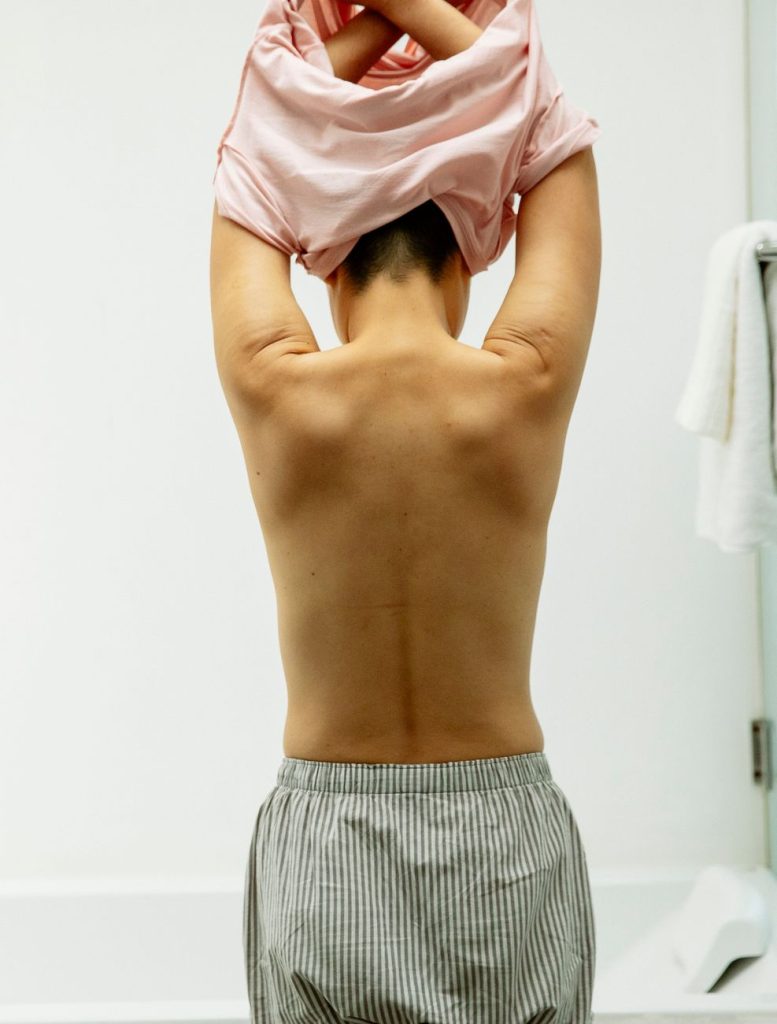
Adolescent scoliosis is often silent. It is frequently detected because the family notices a higher shoulder, a more prominent scapula, clothing that hangs unevenly or an asymmetric waist. Sometimes there is a trunk lean to one side or a rib prominence when bending forward. Other times the finding occurs during a pediatric or school check-up.
Pain is not the dominant symptom in adolescent scoliosis, and when present it should be carefully evaluated. Mild, nonspecific pain can accompany the deformity, but severe, persistent, nocturnal or disproportionate pain necessitates considering causes other than scoliosis. The same applies if tingling, weakness, changes in gait or sphincter disturbances appear. In those cases, the priority is not “watchful waiting” but expanding the workup.
Warning signs that make prompt evaluation advisable include rapid progression of asymmetry, the onset of significant pain, marked stiffness, neurological impairment, a very visible curve developing in a short time or suspicion that the scoliosis may not be truly idiopathic. Scoliosis that appears before puberty, that is accompanied by general signs, or that does not fit the usual course during growth also deserves special attention.
How it is diagnosed: examination and imaging
The diagnosis of adolescent scoliosis begins with a detailed medical history and a complete physical examination. The specialist observes shoulder, pelvic and trunk alignment, palpates the spine, assesses vertebral rotation with the Adams forward bend test and checks strength, sensation and reflexes. Biological maturity and growth stage are also evaluated, because that information conditions the likelihood of progression and, therefore, the treatment.
The basic imaging test is a standing spinal radiograph, usually taken with the patient upright, because it allows precise measurement of the Cobb angle and comparison with previous studies. Full-spine projections are requested depending on the case to see the curve pattern, its location and its global behavior. The important thing is not only to “see the scoliosis,” but to know how large it is, where it is and whether it changes over time.
In a typical adolescent scoliosis, MRI is not always necessary. It is reserved for specific situations: atypical pain, neurological abnormalities, unusual-appearing curves, rapid progression or suspicion of a secondary cause. That nuance matters because not every scoliosis requires a battery of tests. In fact, part of good practice is precisely avoiding overdiagnosis and excessive medicalization of an adolescent with a small, stable curve.
Non-surgical treatment options
In adolescent scoliosis, the most frequent option when the curve is mild and remaining growth is limited is observation. Observation does not mean “doing nothing,” but monitoring the evolution with periodic check-ups and X-rays when indicated. This strategy is usually chosen for small curves without clear progression and without major risk factors. The follow-up interval is individualized according to age, skeletal maturity and curve magnitude.
When the risk of progression is higher, the brace comes into play — an external orthosis designed to slow the advancement of the deformity while the adolescent is still growing. The brace does not “cure” adolescent scoliosis nor completely erase the curve; its real goal is to reduce the probability that the deformity will worsen to a range that ultimately requires surgery. It works best in immature patients, with curves in an intermediate range and with correct adherence to the prescribed wearing time.
The brace does not replace patient education or adherence. Wearing it for the indicated hours is a decisive part of treatment, and the family needs a clear explanation to avoid frustration. It can also be accompanied by physiotherapy or scoliosis-specific exercises in selected cases, although these measures are complementary. Their main value is usually improving postural control, function and tolerance to treatment, rather than correcting a structural curve by themselves.
The big question families often ask is: “If the curve doesn’t hurt, why treat it?” The answer is that the goal is not to relieve an immediate symptom but to modify the risk of progression during growth. That is why the decision is made not only by looking at the number of degrees but also at the adolescent’s stage of development and the speed at which the curve is changing.
Surgical options
Surgery is not the first step in adolescent scoliosis, but it is considered when the curve is large, progresses despite conservative treatment or presents a significant risk of continued worsening. The most common procedure is spinal fusion, also called vertebral fusion, in which several spinal segments are corrected and stabilized using implants and bone graft. The goal is to prevent the curve from advancing and to improve trunk balance.
In some selected patients, fusionless techniques such as growth modulation are being studied, but their indication is much more restricted and depends on anatomical factors, age and remaining growth potential. It is not a universal solution nor an automatic alternative for any adolescent scoliosis. The choice depends on a very precise specialized assessment.
It is important to state clearly: in adolescent patients, surgery is not decided for isolated cosmetic reasons or family anxiety, but based on objective clinical and radiographic criteria. Surgical referral aims to prevent a progressive curve from compromising balance, body appearance, function and quality of life in the medium and long term.
Benefits, risks and adverse effects
The main benefit of observation is avoiding unnecessary treatments in curves that are unlikely to progress. Its limitation is clear: if adolescent scoliosis advances between visits, the window to intervene in time may narrow. That is why observation must be active, not passive.
The brace can decrease the risk of progression and increase the likelihood of remaining below higher-risk thresholds. Its most common adverse effects are skin irritation, discomfort, difficulty adapting socially and, in some cases, poorer adherence. It is not usually a “pleasant” treatment, and precisely for that reason it needs support, explanation and follow-up.
Surgery offers correction and stabilization of the most significant curves but involves risks that must be explained honestly: bleeding, infection, postoperative pain, mechanical implant failures, need for reoperation and prolonged recovery. In selected adolescents, functional outcomes are often good, but surgery should not be presented as a simple response to a striking X-ray. It always requires weighing expected benefit against the burden of the procedure.
Criteria for referral to a specialist
Referral to a spine specialist or spinal surgeon is indicated when adolescent scoliosis exceeds the scope of simple surveillance in primary care or pediatrics. In practice, referral is advisable if the curve progresses, if the Cobb angle reaches a range in which bracing may be considered, if the adolescent is still growing and the curve shows risk of worsening, or if there are clinical warning signs.
Referral is also required for significant pain, neurological findings, suspicion of non-idiopathic scoliosis, marked thoracic asymmetry or doubts about interpreting the radiograph. Families often seek a simple answer, but the correct decision depends on combining radiographic measurement, remaining growth and temporal evolution.
Practically speaking, adolescent scoliosis deserves specialized assessment when it ceases to be a mild, stable variant. If the curve approaches clinically relevant thresholds, if the adolescent is still growing or if there is diagnostic uncertainty, study should not be delayed.
Realistic recovery times
Adolescent scoliosis managed with observation does not have “recovery” in the classic sense but rather follow-up. The goal is to monitor progression until skeletal maturity is reached or to decide on another strategy if the curve changes. In this scenario, it is normal to talk about months or years of periodic monitoring.
With a brace, adaptation usually takes several weeks. Initially there may be discomfort, doubts and some resistance, especially in adolescents who see the treatment as a visible sign of illness. The emotional adaptation period is often as important as the physical one. In the long term, effectiveness depends on adherence during the remaining growth.
If surgery is planned, recovery is longer and requires individualized planning. Return to daily life, school activities and exercise should be gradual and supervised. There is no single valid timeframe for everyone, because the extent of surgery, the patient’s maturity and postoperative course influence recovery. It is prudent to avoid both expectations of instant recovery and the idea that everything will be limited for many months in an unchanging way.
When to go to the emergency department
Adolescent scoliosis alone is rarely an emergency. However, there are situations that require rapid evaluation: sudden onset of intense pain, leg weakness, loss of sensation, difficulty walking, urinary or bowel disturbances, fever associated with back pain, major trauma or very rapid worsening of the deformity. These signs do not fit the usual course of a stable idiopathic scoliosis.
It is also advisable to seek prompt care if persistent nocturnal pain appears, unexplained weight loss or a new neurological change. In those cases, the goal is not to confirm routine adolescent scoliosis but to rule out another condition that may require urgent treatment.
Myths and realities
Myth: “Adolescent scoliosis always needs surgery”
Reality: most cases do not reach surgery. Many curves are monitored without intervention and others are treated with a brace if the risk of progression justifies it.
Myth: “If it doesn’t hurt, it doesn’t need monitoring”
Reality: adolescent scoliosis can progress without pain. Follow-up is decided by the curve, growth and evolution, not only by symptoms.
Myth: “The brace straightens the back forever”
Reality: the brace aims to slow progression during growth. It is not a definitive correction and does not work the same for every patient.
Myth: “Adolescent scoliosis is caused by poor posture”
Reality: posture can make the asymmetry more visible, but it is not the cause of idiopathic scoliosis. The deformity has a multifactorial origin related to growth.
Myth: “All scolioses evolve the same way”
Reality: some curves remain stable and others progress. Initial size, skeletal maturity and location strongly influence the course.
Frequently asked questions
Does adolescent scoliosis always worsen with growth?
No. Some curves remain stable or barely change. The risk of progression depends mainly on the curve angle and how much growth remains.
When is a brace used in adolescent scoliosis?
It is considered when the curve has a relevant risk of progression and the adolescent is still growing. The decision is based on the X-ray, skeletal maturity and the curve’s evolution.
Does the brace require stopping sports?
Not necessarily. Physical activity should be individualized, and in many cases part of the usual exercise is maintained. The specialist should indicate what is appropriate according to the curve and the type of activity.
Does adolescent scoliosis always cause back pain?
No. Often it does not produce pain. If the pain is significant, persistent or atypical, other associated or different causes should be evaluated.
What is the Cobb angle?
It is the standard radiological measure to quantify scoliosis. It allows tracking the curve’s evolution and helps decide between observation, bracing or surgical referral.
Does adolescent scoliosis correct itself?
It usually does not correct itself if a structural deformity already exists. Some curves may remain stable, but others progress, hence the importance of follow-up.
When is it appropriate to ask for a second opinion?
When there are doubts about the indication for a brace or surgery, when the curve progresses rapidly or when the family needs more clarity about prognosis and the follow-up plan.
Glossary of medical terms
- Cobb angle: radiographic measure that quantifies the magnitude of the scoliotic curvature.
- Skeletal maturity: degree of bone development indicating how much growth remains.
- Risser: system that assesses pelvic bone maturation and helps estimate remaining growth.
- Vertebral rotation: rotation of the vertebrae around their axis, characteristic of structural scoliosis.
- Brace: external orthosis designed to slow curve progression during growth.
- Orthosis: external medical device that modifies or controls a body structure.
- Spinal fusion: surgical fusion of vertebrae to stabilize and correct a deformity.
- Active observation: periodic clinical and radiological follow-up to detect progression.
- Adams forward bend test: examination maneuver in which the patient bends forward to detect a rib hump or rotation.
- Curve progression: increase of the deformity over time on successive radiographs.
References
- AANS, Scoliosis, 2024. https://www.aans.org/patients/conditions-treatments/scoliosis/
- AAOS OrthoInfo, Idiopathic Scoliosis in Children and Adolescents, 2024. https://orthoinfo.aaos.org/es/diseases–conditions/idiopathic-scoliosis-in-children-and-adolescents/
- PrevInfad, Cribado de la escoliosis idiopática del adolescente, 2026. https://previnfad.aepap.org/recomendacion/escoliosis-rec
- AEPap, Algoritmo de cribado de la escoliosis idiopática del adolescente, 2025. https://algoritmos.aepap.org/algoritmo/118/cribado-de-la-escoliosis-idiopatica-del-adolescente
- PubMed, Establishing consensus on the best practice guidelines for the use of bracing in adolescent idiopathic scoliosis, 2020. https://pubmed.ncbi.nlm.nih.gov/32026441/
- PubMed, The Effectiveness of Different Concepts of Bracing in Adolescent Idiopathic Scoliosis: A Systematic Review and Meta-Analysis, 2021. https://pubmed.ncbi.nlm.nih.gov/34063540/
- PubMed, Scoliosis and Prognosis-a systematic review regarding patient-specific and radiological predictive factors for curve progression, 2021. https://pubmed.ncbi.nlm.nih.gov/33772381/
- PubMed, The natural history of adolescent idiopathic scoliosis, 2010. https://pubmed.ncbi.nlm.nih.gov/20165671/
- PubMed, Adolescent Idiopathic Scoliosis – StatPearls, 2021. https://www.ncbi.nlm.nih.gov/books/NBK499908/?report=printable
- PMC, Back pain and scoliosis in children: When to image, what to consider, 2017. https://pmc.ncbi.nlm.nih.gov/articles/PMC5602330/
Notice: this content is for educational and informational purposes only and does not replace the assessment, diagnosis or treatment of a qualified healthcare professional. For an individual evaluation, you can request an evaluation at Complex Spine Institute.