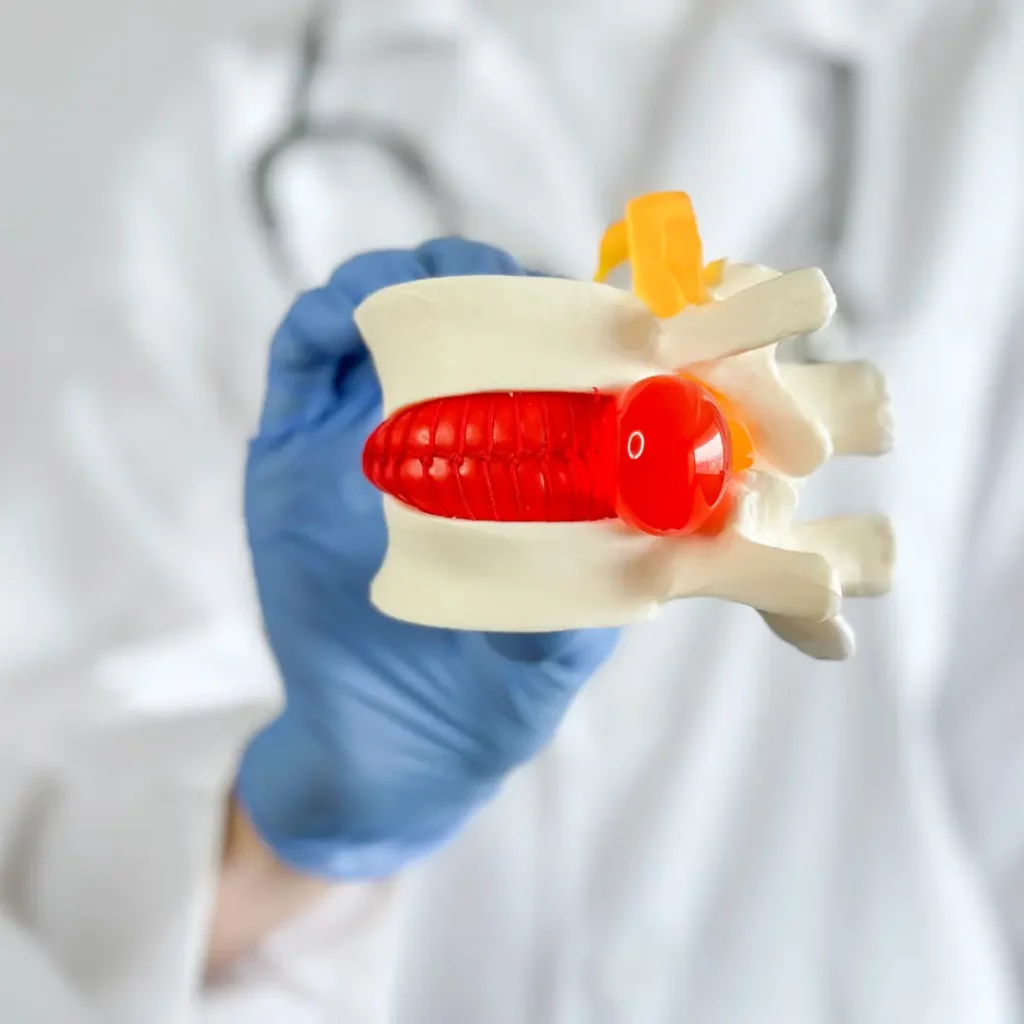
Pain running down the arm, tingling in the hand, weakness when gripping objects or a sensation of electric shock when moving the neck are symptoms many people attribute to a muscle spasm, stress or a “bad movement.” Sometimes they are. But other times the origin is a cervical disc that has moved out of place and is irritating or compressing a nerve root. This guide explains which signs point to a cervical disc herniation, how it is diagnosed without relying solely on MRI, and in which situations surgery truly becomes part of the discussion.
- Cervical disc herniation does not always cause significant neck pain. Often the arm is what bothers most.
- MRI is very helpful, but it does not decide on its own. It must match the symptoms and the neurological examination.
- Many people improve without surgery with time, pain control, adapted activity and well-directed rehabilitation.
- Surgery is usually considered when there is persistent disabling pain, progressive loss of strength or signs of spinal cord compression.
- Worsening weakness, clumsiness in the hands, problems walking or bladder or bowel changes require urgent evaluation.
What is a cervical disc herniation and why it is often confused
Between each pair of vertebrae there is a disc that acts as a shock absorber. When part of that disc shifts and comes into contact with a nerve root or the spinal cord, pain, tingling, numbness or weakness can appear. If this occurs in the neck area, we refer to it as a cervical disc herniation.
Confusion is common because the body does not always “signal” where the problem is. Some people with a cervical hernia notice almost no neck pain and instead consult for pain in the shoulder blade, shoulder, arm or fingers. Others describe cramps, electric-shock sensations, loss of hand precision or a feeling of a clumsy arm. That is why it can be mistaken for tendinitis, a painful shoulder, muscle overload or even anxiety.
Also, seeing a herniation on MRI does not automatically mean it is the cause of the symptoms. There are also “silent” herniations. The key is not a single image, but that the symptoms, the examination and the tests all point in the same direction.
9 signs worth taking seriously
1. Pain that travels from the neck to the shoulder, arm or hand
This is the most typical sign. It usually follows a more or less recognizable nerve distribution and many people describe it as burning, an electric shock or deep pain that “runs” down the arm.
2. Tingling or numbness in specific fingers
It does not always affect the whole hand. Sometimes it is concentrated in the thumb and index finger, other times in the middle, ring or little finger, depending on which root is irritated.
3. Weakness when gripping, opening jars or lifting the arm
When the nerve not only hurts but begins to function worse, everyday movements can fail. This sign weighs much more than the simple intensity of the pain.
4. Pain that worsens when moving the neck or looking up
It is not universal, but it is suggestive. Some positions temporarily reduce the space around the nerve and make the arm “flare up.”
5. Shoulder blade or interscapular pain without a clear shoulder cause
In many patients, the main discomfort is neither in the neck nor the hand, but around the scapula. That can be quite misleading.
6. Symptoms that wake you at night or when sleeping on your side
Rest does not always relieve symptoms. Some people sleep worse because certain neck or shoulder positions increase nerve irritation.
7. Partial improvement of pain, but persistent clumsiness or loss of strength
Less pain does not always mean everything is fine. If function does not improve or worsens, re-evaluation is necessary.
8. Clumsiness in the hands, worse balance or an unusual gait
This sign no longer points only to radiculopathy, which is involvement of a nerve root, but forces consideration of possible myelopathy, that is, involvement of the spinal cord. The level of attention changes here.
9. Symptoms that do not fit a simple muscle contracture
A contracture can be very painful, but it usually does not explain a well-defined sensory loss, objective weakness or an electric sensation running down the arm in a nerve pattern.
How it is diagnosed
A reasonable diagnosis begins with a detailed clinical history. It is important to know where the pain started, where it radiates, whether there is tingling, which movements worsen it, whether there is loss of strength and how much it is affecting daily life.
Next comes the neurological examination. Strength, reflexes, sensation and provocative maneuvers are checked here. This helps localize which root may be involved and, above all, to detect signs of spinal cord compression.
MRI is usually the most useful test when symptoms are persistent, severe, progressive or when an invasive strategy is being considered. But it has limits: an impressive image does not oblige surgery, and a large herniation does not always mean more pain or a worse outcome.
In some cases, dynamic X-rays, CT scans or neurophysiological studies are also valuable, especially when there are diagnostic doubts, prior surgery, suspicion of instability or discordance between clinical findings and imaging.
Non-surgical alternatives
Many cervical disc herniations improve without surgery. This does not mean “putting up with it and doing nothing,” but following a well-guided conservative plan.
Options usually include prudent analgesia, maintaining adapted activity, physiotherapy with reasonable progression, postural education and measures to sleep or work with less nerve irritation. In certain cases a cervical injection may also be considered, although it is not a magic solution nor indicated for everyone.
The key to conservative treatment is twofold. First, relieve pain so the person can move again. Second, monitor whether the evolution is heading in the right direction. Severe pain at the beginning does not force surgery. What worries most is progressive functional deterioration or lack of real improvement after a reasonable time.
When surgery truly becomes part of the conversation
Surgery is not considered because an MRI “looks impressive,” but because the balance between symptoms, function, time and risk suggests that continuing to wait no longer adds much or may worsen the prognosis.
In general, surgery gains weight in four scenarios:
- intense and persistent radicular pain that does not improve with well-executed conservative treatment,
- progressive weakness or clear functional loss,
- signs of spinal cord compression,
- discordance between what the person can do and what would be reasonable to expect after several weeks or months of non-surgical management.
There is not a single operation for all cases. Among the best-known options are anterior cervical discectomy with fusion, cervical disc replacement and posterior cervical foraminotomy. The choice depends on the affected level, the type of compression, whether there is arthritis or instability, neck alignment and the real clinical objective.
Put simply: it is not only a matter of “removing a hernia,” but choosing the technique that best decompresses the nerve with the least reasonable cost for that particular neck.
Benefits, risks and adverse effects
Expected benefits
When the indication is appropriate, surgery can relieve radiating arm pain sooner, halt strength loss and reduce the risk that spinal cord compression will continue to deteriorate function. In selected people, it also improves sleep, work capacity and quality of life.
Risks and limits
No technique guarantees a perfect result. Possible risks include infection, bleeding, nerve injury, transient hoarseness, difficulty swallowing in anterior approaches, segmental stiffness with fusions, need for repeat surgery and partial persistence of tingling or weakness if the nerve has been damaged for a long time.
It is also important to understand a somewhat counterintuitive idea: pain often improves before sensation or strength. The nerve can take weeks or months to recover, and in some cases recovery is not complete. Therefore operating late, when a prolonged deficit already exists, can limit the outcome.
Referral criteria
It is advisable to refer or re-evaluate with higher priority if any of these situations appear:
- new or worsening weakness in the arm or hand,
- radicular pain that prevents sleeping, working or self-care normally,
- persistent symptoms despite correct conservative management,
- fine motor clumsiness in the hands, balance problems or unsafe gait,
- significant doubts between a cervical origin, shoulder or another neurological cause.
Realistic recovery times
There is no single timetable. With conservative treatment, some people improve clearly in a few weeks and others need more time. The goal is not that the MRI changes quickly, but that pain, function and strength move in the right direction.
After surgery, arm pain can be relieved early, but residual tingling and weakness can take longer. Light activities are usually resumed before physical work. Recovery depends on the technique chosen, the number of levels, the prior state of the nerve, age and overall health.
The most sensible expectation is this: rapid improvements in some symptoms do not exclude a slower neurological recovery. And a slow recovery does not automatically mean a poor outcome.
When to go to the emergency department
There are symptoms that should not wait for a routine appointment:
- rapidly progressing weakness,
- increasing difficulty walking or a feeling of clumsy legs,
- marked loss of dexterity in both hands,
- new bladder or bowel changes,
- uncontrollable pain accompanied by neurological deterioration.
These signs require ruling out spinal cord compression or other causes that change the urgency.
Myths and realities
Myth: if MRI shows a hernia, surgery is required
Reality: the image does not rule alone. It matters that it explains the symptoms and the examination.
Myth: if my arm hurts, the problem is in the shoulder
Reality: much pain of cervical origin is felt mainly in the shoulder, scapula, forearm or hand.
Myth: if I endure it long enough, it will always go away
Reality: many people improve without surgery, but progressive weakness or myelopathy are not scenarios for waiting without control.
Myth: surgery restores the neck to zero
Reality: surgery aims to decompress and improve function and pain, not to completely erase all degenerative change or guarantee identical recovery in all patients.
Frequently asked questions
Does a cervical disc herniation always cause neck pain?
No. In many people what bothers most is the arm, the scapula or the hand, not the neck.
Can it heal on its own?
Many improve with conservative treatment and time. That does not mean ignoring symptoms, but monitoring that the course is favorable and that progressive deficit does not appear.
How long is usually waited before considering surgery?
It depends on the intensity of the pain, the response to conservative treatment and, above all, whether there is progressive weakness or signs of spinal cord compression. Not all cases should wait the same amount of time.
Is MRI enough to decide?
No. MRI is very important, but it must be correlated with symptoms and examination. There are visible hernias that do not explain well what the person feels.
What is the difference between fusion and cervical disc replacement?
Fusion stabilizes the segment and the prosthesis also tries to preserve motion. They are not interchangeable for all patients. Anatomy, arthritis, stability and the clinical objective determine which makes more sense.
Does surgery relieve pain faster than tingling?
Often yes. Radicular pain can be relieved earlier, while the nerve takes longer to recover sensation and strength.
Can I exercise if I have a cervical hernia?
In general yes, but adapted. The usual advice is to avoid movements that trigger symptoms and follow a guided plan to avoid excessive rest or overload.
When should I really be worried?
When progressive weakness, hand clumsiness, balance problems, unbearable pain that does not subside or symptoms compatible with spinal cord involvement appear.
Glossary
Herniated disc: displacement of part of the intervertebral disc outside its usual position.
Radiculopathy: symptoms caused by irritation or compression of a nerve root.
Myelopathy: alteration due to compression of the spinal cord.
Magnetic resonance imaging: an imaging test very useful to see discs, nerves and the cord.
Foraminotomy: surgery to enlarge the canal where a nerve root exits.
Cervical fusion: surgery that joins two vertebrae to stabilize the treated segment.
Cervical prosthesis: an implant that replaces the disc and aims to maintain motion in selected cases.
Neurological deficit: loss of strength, sensation, reflexes or dexterity due to nerve involvement.
References
- Reemplazo de disco cervical: qué es, beneficios y cuándo está indicado
- ACR Appropriateness Criteria – Cervical Pain or Cervical Radiculopathy – 2024
- Conservative Management of Cervical Radiculopathy: A Systematic Review – 2023
- Posterior Cervical Foraminotomy Compared with Anterior Surgery for Cervical Radiculopathy – 2024
- Comparative Network Meta-Analysis of ACDF and Cervical Disc Arthroplasty – 2024
- Ten-Year Outcomes of Cervical Disc Arthroplasty Versus ACDF – 2024
- Neurological Examination for Cervical Radiculopathy – 2025
This content is educational and does not replace an individual medical evaluation.